I am interested in the changes of tour guides in the tourism industry. When visitors have sightseeing activities in certain places such as museums, historic heritage, natural scenery, and so on, the staff can be found to assist the visitors in the service centre or the tourist information centre during the tour. The traditional tour guide plays a significant role in the tourism industry. They have rich knowledge about the attractions to help the visitors get a better understand of the attractions, but they get some limitations by the time and cost constraint. Therefore, the tour guide system and the tour guide robot are built up to meet the demand of increasing tour efficiency while minimizing resources required.
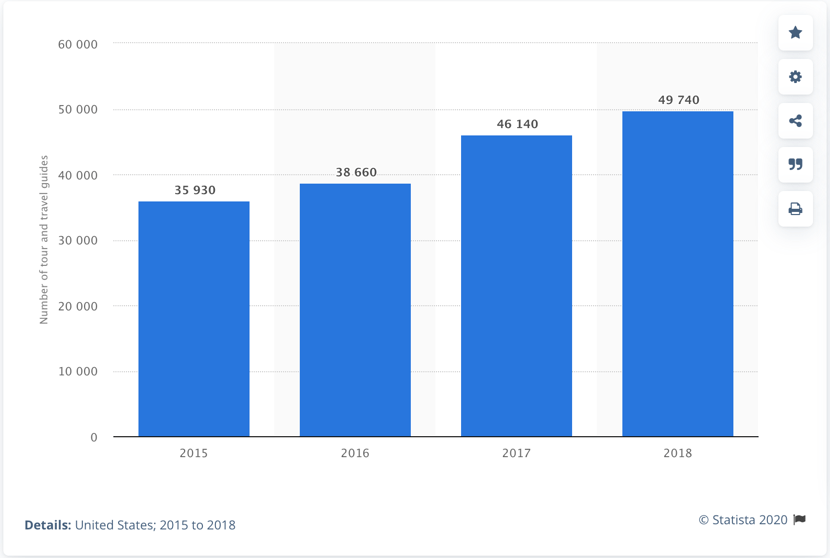
There are a large number of tour and travel guides employed in the United States from 2015 to 2018 (statistic, 2020).
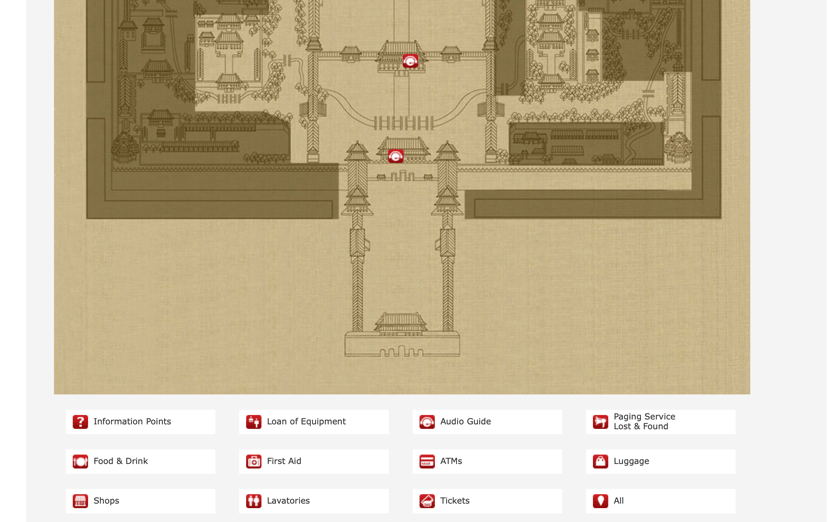
With the development of technology, audio tour guide machines have become standard tools to help visitors understand the attractions. Visitors are used to renting and returning the audio tour guide in the entrance and the exit. Not only the cost of the audio tour guide is lower than a traditional tour guide, but visitors also have more freedom to choose different kinds of service. For example, the seniors may need higher volume, and visitors from different countries and regions may need different language choices. These demands can be meet by providing more personalized information to each visitor by using the tour guide system. Also, the audio tour guide can ensure the visiting experience of tourists to a greater extent. Traditional tour guides need to use loudspeakers to ensure that every visitor in the group can hear the explanation. However, the use of speakers in the room will be boisterous to tourists who want a quiet sightseeing environment and affect their tour experience. The palace museum of China set two places for visitors to get access to the audio guide.
The audio and multimedia guides based on smartphone technologies are widely used in sightseeing. For example, visitors can listen to the introduction of each scenic spot by scanning the QR code by using their cell phones, which is very convenient and nearly no cost for the visitors. The way of scanning QR code might not so user-friendly to the seniors who are not familiar with using the cell phones, which should also be considered by the management of the attractions. An “in the wild” study showed the use of technologies has an impact on visitors’ experience (Petrie et al., 2017). There was a significantly more positive visitor experience for visitors with a smartphone guide. This part of participants also spent more extended time on visiting. Another research presented an indoor location-aware portable device aiming at improving the visitors’ experience during a tour of an indoor facility (Aman et al., 2017). A Raspberry Pi 3 with Bluetooth Low Energy (BLE) and Wi-Fi transceivers are used to support this module to assist visitors based on their location and providing personalized audio-visual information.
In the future, there is an increasing number of technologies used to enrich visitors’ experience, including VR and AR, and tour guide robots will be widely used in museums and exhibitions. An interactive museum tour using augmented reality technology already used in Egyptian Museum to allow visitors being shown around by Ancient Egypt’s famous pharaoh Tutankhamun (MINTEL, 2018). The program found that visitors with wearing the headset stay five to seven minutes in front of the exhibits rather than five to fifteen seconds without it, which provide a more memorable and in-depth experience for visitors.

VISTA AR, the Interreg France (Channel) England project, leading by the University of Exeter, aims to develop an understanding of visitor experiences, create new VR and AR digital tools, and explore new business models and opportunities presented by digital technology (. The project is a significant step in providing cultural heritage sites with an effective way to enhance visitor experiences while increasing visitor numbers and revenue.
The long-term deployment of autonomous robots co-located with humans in real-world scenarios remains a challenging problem. Further research about how these new museum guides can optimally interact with visitors can be challenging. Velentza, Heinke, and Wyatt (2019, October) proved that the personality of the robot affected the human learning process and found that people remember significantly more information when a cheerful robot guides them than when their guide is a serious one. These results inspire scientists who are considering to design tour-guide robots.
Reference
Aman, M. S., Quint, C. D., Abdelgawad, A., & Yelamarthi, K. (2017, March). Sensing and classifying indoor environments: An Iot based portable tour guide system. In 2017 IEEE Sensors Applications Symposium (SAS) (pp. 1-6). IEEE.
MINTEL. (2018). Pharaoh Tour Guide.
Petrie, H., Othman, M. K., & Power, C. (2017). Smartphone Guide Technology in Cultural Spaces: Measuring Visitor Experience with an iPhone Multimedia Guide in Shakespeare’s Church. International Journal of Human–Computer Interaction, 33(12), 973-983.
Statista. (2020). Total number of tour and travel guides employed in the United States from 2015 to 2018.
The palace museum. https://en.dpm.org.cn/visit/facilities/?id=3#facont
Velentza, A. M., Heinke, D., & Wyatt, J. (2019, October). Human Interaction and Improving Knowledge through Collaborative Tour Guide Robots. In 2019 28th IEEE International Conference on Robot and Human Interactive Communication (RO-MAN) (pp. 1-7). IEEE.
 Stephanie's blog
Hey Stephanie!
It is so nice to see your article here! I really love the way you combined pics with the article which makes the article more attractive! What a fun topic about how digital business changed the way that tour guide works. I’ve noticed that when I was travelling, there’s always some robot tour guides such as the audio tour guide machine. It is surprisingly to know that this could definitely improve tourists’ experience, comparing with traditional tour guides, this could make sure that everyone can hear the info. The most impressive part is about the VR and AR technology’s widely launched in the tourism industry to help with improving the guest experience. In the future, it is foreseeable that high tech devices will help and replace human tour guides in the tourism industry, and tourists will get a better experience from that.
Thanks a lot for showing us such an interesting article. It was delightful to read your article, the topic is a novelty.
赞Liked by 1 person
Hi Jinyi Xu!
After reading your blog, I have a better understanding of the tourism industry and the application of technology! Indeed, I have noticed that more and more tourist attractions, such as museums, historical sites and other attractions are equipped with audio guide machines. The high-tech can indeed make visitors will make maximum use of your time to understand the history and background of the art at the same time as your blog said it also solves the different tourists demand, such as the elderly can adjust the volume, but also saved a well-paid spending a lot of tour guide and to provide an additional help guide work. Your article also talked about the application of modern digital tourism, such as mobile phone scan qr code to understand the information of art and provide relevant professional evidence, very interesting! In the end, you also briefly mentioned our digital technology project sponsored by Exeter which also interested me a lot!
I like the style of your blog, you gave me a lot of text and visual information, especially pictures and videos, which can make me more convenient to understand the data and information, make your article easy to read and at the same time very interesting, thank you for sharing, looking forward to your next blog!
Xiaoyu Hua
赞Liked by 1 person
It is amazing to see how the tour guide developed in these years. A few years ago, before audio Tours became widely available, my mother and I went on group Tours. The whole trip was great, and we saw a lot of architectures we hadn’t seen before, but the downside was that we were so far away from the guide that we sometimes couldn’t hear her explain the history and the meanings of stuff. All we took home were photos and souvenirs, but we couldn’t remember anything about the events. And what the writer mentioned in the article is vital is the character of the guide, about the tone of their speech or the sense of humour, etc., the dull explanation made me feel sleepy, the guide or robot who mixed wild history and joke with the stuff is always more popular. Last month, I visited the fashion museum in Bath, where a staff handed out audio directions at the entrance and asked me what language I needed to set. During the whole tour, I could not only appreciate the exquisite clothes of the past but also understand the local history by listening to the native language, which I felt comfortable with. I’ve been to museums that don’t have audio navigation, and I’ve spent too much time looking at unfamiliar words in the description of the object and do not have enough time looking at the shape of the object. Therefore, this trip to the fashion museum not only provided me with visual enjoyment but also broadened my horizon. I think the role of voice navigation is getting more important. The AR and VR technologies that have been developed makes me even more excited to look forward to. It is always more impressive to participate in the production process by oneself or to experience the atmosphere at that time than to listen to others’ descriptions. If I had the chance to experience being a king, I would remember that feeling for the rest of my life hahaha.
赞Liked by 1 person
Thanks for your reply! I’m really glad about your great experience in Bath.
赞赞